10 Best Telescope of 2026, Picked for UK Skies and First-Time Stargazers
So here's the problem with shopping for the best telescope: the boxes shout about 240x or 350x magnification, the least useful number on them. After weeks with UK roundups, spec sheets and amazon.co.uk listings, my pick for most first-time stargazers is the Celestron StarSense Explorer DX 130, a 130mm reflector that uses your phone to show you where to point it.
One thing up front: none of these ten has been set up in my garden. It's a research-built list, five picks have no reviewer behind them, and I flag each one. Smart telescopes from Dwarflab, ZWO and Vaonis sit alongside classic scopes, because light-polluted British skies are where they earn their place.
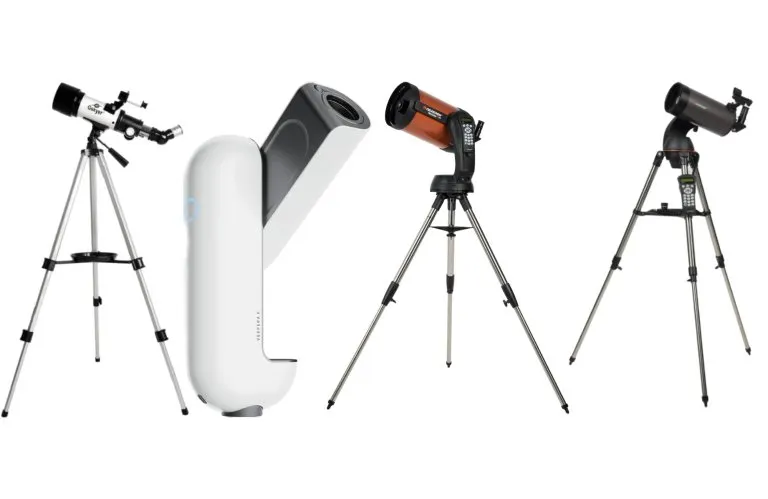

- Clear lunar detail: The 130mm mirror gathers plenty of light. Craters look crisp.
- Easy target finding: StarSense reads the sky via your phone. Arrows point the way.
- Quick garden setup: Manual alt-azimuth mount with slow-motion knobs. No motors to align.
- Useful bundled extras: 25mm and 10mm eyepieces, phone dock and full-height tripod included.
- Low-fuss for beginners: A green bullseye means you're on target. Then just look.
- Room to grow: Better eyepieces can swap in later. The optics justify upgrades.
- Bulky tube: A 130mm reflector on a full tripod is sizeable. Plan where it lives indoors.

- Clear lunar detail: The 150mm parabolic mirror is the largest here. Rich lunar detail.
- Easy target finding: A reflex finder projects a dot. Aim, then centre the target.
- Quick garden setup: Pull the collapsible tube out and set it down. Done.
- Useful bundled extras: 25mm and 10mm eyepieces included. Enough for a first season.
- Low-fuss for beginners: The Dobsonian base has no settings. Nudge the tube along.
- Room to grow: Fast f/5 optics and a helical focuser. Takes filters later.
- Needs a table: The tabletop base must sit on a sturdy table, wall or garden stool.

- Clear lunar detail: A 737mm equivalent focal length frames the Moon. Stacking sharpens detail.
- Easy target finding: App-controlled auto-tracking finds targets. No paper star charts needed.
- Quick garden setup: It weighs 1.35kg and fits a backpack. Add a tripod.
- Useful bundled extras: Magnetic solar filters, carrying bag and USB-C cable in the box.
- Low-fuss for beginners: Cloud processing in the app cleans images. No PC software.
- Tiny planets: A 35mm lens makes planets small. It's a camera, not an eyepiece scope.

- Clear lunar detail: Apochromatic quadruplet optics cut colour fringing. Clean Moon images.
- Easy target finding: Automatic GoTo and tracking. The app finds objects for you.
- Quick garden setup: Roughly 1.65kg in one unit. Power on and connect.
- Useful bundled extras: Built-in UV/IR cut and dual-band filters. Handy under streetlights.
- Low-fuss for beginners: One-tap deep-sky and Moon modes. Mosaics stitch together automatically.
- No eyepiece: You view everything on a phone or tablet screen. There is no eyepiece.

- Clear lunar detail: A 30mm lens with six elements in three groups. Neat Moon portraits.
- Easy target finding: The app guides your phone's camera onto targets. Little knowledge needed.
- Quick garden setup: Small, light unit with a tripod in the pack. Clip in your phone.
- Useful bundled extras: The Ultimate Pack adds a solar filter and tripod. A complete kit.
- Low-fuss for beginners: Uses the phone you already own as its camera. Fewer parts.
- Phone dependent: Image quality depends on your phone's camera. Older phones will limit results.

- Clear lunar detail: An 80mm lens at 900mm focal length. Crisp Moon views.
- Easy target finding: A 5x24 crosshair finder scope. Line up bright targets first.
- Quick garden setup: Aluminium tripod with altitude and azimuth scales. Simple to assemble.
- Useful bundled extras: 10mm and 20mm eyepieces, erect diagonal and phone adapter included.
- Long tube: The 900mm tube is long. It will catch the wind on breezy evenings.

- Clear lunar detail: A 70mm lens at 350mm fits the whole Moon in view.
- Easy target finding: A 5x24 finder scope included. The wide field is forgiving.
- Quick garden setup: Height-adjustable aluminium tripod assembles quickly. Easy to carry around.
- Useful bundled extras: 20mm, 12.5mm and 4mm eyepieces, smartphone holder and tripod bag.
- Weak 4mm eyepiece: The 4mm eyepiece pushes a short refractor too hard. Images turn soft.
- Colour fringing: The fast achromatic lens shows purple edges on bright objects. Normal at this level.

- Clear lunar detail: 90mm aperture at 800mm focal length. Shows Jupiter's cloud belts.
- Easy target finding: The 25mm eyepiece gives a wide 32x view. Start there.
- Quick garden setup: Stainless steel tripod adjusts from 73cm to 118cm. Suits most heights.
- Useful bundled extras: Phone adapter, moon filter, 3x Barlow and carry bag included.
- Magnification hype: The 240x top figure is optimistic. British seeing rarely allows anything close.
- Heavy kit: Listed at 5.58kg all in. Heavier than the 70mm travel scopes here.

- Clear lunar detail: 70mm aperture at 400mm focal length. Fine for lunar craters.
- Easy target finding: A 5x24 finder with crosshairs. Lines up the Moon easily.
- Quick garden setup: Aluminium alloy tripod and carry bag. Everything packs away together.
- Useful bundled extras: Two eyepieces, 3x Barlow, phone adapter and camera remote included.
- Listing-only pick: No editorial support turned up. The ranking rests on its spec sheet.
- Barlow softness: The bundled Barlow lens softens the view. Stick to the eyepieces for sharpness.

- Clear lunar detail: The 70mm lens shows craters clearly. A moon filter cuts glare.
- Easy target finding: A 5x24 crosshair finder included. Aim first, then focus.
- Quick garden setup: Assembles without tools in minutes. Tripod height adjusts easily.
- Useful bundled extras: Three eyepieces, Barlow lens, star diagonal and phone adapter included.
- Low-fuss for beginners: The star diagonal gives a right-way-up image. Less confusing.
- Huygens eyepieces: Basic Huygens eyepieces give narrow, soft views. Upgrading them helps noticeably.
- 150x claim: The 150x Barlow figure overpromises. Expect soft, dim images at that power.
- Unknown brand: A little-known Amazon brand with no reviewer backing. Judged on listing data.
Other Telescopes Worth Considering

- An 80mm aperture in a short, packable tube.
- Fully multi-coated optics, per the listing.
- Fits a travel backpack for trips away.
- No reviewer backing found in our research.
- The short, fast lens shows some colour fringing.

- Two eyepieces plus a 3x Barlow lens.
- A phone adapter for simple Moon snaps.
- Scope and tripod pack into one backpack.
- Little-known brand with no editorial backing.
- Its 90x figure needs steady air to look sharp.

- A 90mm lens gathers more light than 70mm kits.
- Includes a phone adapter and wireless remote.
- Comes with a storage bag for trips.
- A newer listing with little track record.
- The 350x top figure is not realistic.

- The shortest tube in this round-up.
- A phone adapter for simple Moon photos.
- No tools needed to set it up.
- Listed in the toy category on Amazon.
- The 150x figure overstates what it can show.
In-Depth Reviews of Our 10 Telescope Picks
Each review turns the spec sheet into what you'd realistically see from a UK garden, and flags the weak spots. Where no reviewer backed a scope, I say so.
#1 · Editor's Choice
Celestron StarSense Explorer DX 130 Newtonian Reflector Telescope, 22461
Judged on how quickly a complete beginner gets from box to Saturn, this is the best telescope in the list, and more than one UK roundup I read backed it. The trick is StarSense: dock your phone, the app recognises the stars overhead, and arrows guide the 130mm tube until a bullseye turns green. The 650mm f/5 optics handle crater walls, Jupiter's belts and Saturn's rings. It isn't small, though, and reflectors need occasional collimation (a fiddly mirror tweak). My back garden has a streetlight right over the fence, which hurts faint galaxies far more than planets.
The verdict: The best telescope for most first-time stargazers here, as long as you have room to store a full-size tube.
#2 · Runner-Up
Sky-Watcher Heritage 150 Tabletop Dobsonian Telescope, S11710
Most beginner scopes give you a long tube on a wobbly tripod. The Heritage 150 does the opposite: a squat tabletop Dobsonian with a 150mm parabolic mirror, the largest aperture on this list, on a base that simply swivels. More light means richer star clusters. The collapsible tube slides shut, which matters because my partner has firm views on how much hallway astronomy gets. Its weak spot is the base. You need a sturdy table, wall or stool, and there's no phone guidance like the Celestron StarSense Explorer's (bring a flask of coffee, honestly).
The verdict: The biggest light bucket on this list, if you're happy to learn the sky without an app.
#3 · Best Smart Telescope
Dwarflab Dwarf 3 Smart Telescope with Solar Filters
If cloud and streetlights have killed your interest in eyepiece astronomy, this is the smart telescope I'd point you to, because you don't look through it at all. It's a 1.35kg camera with a 35mm telephoto lens, a wide-angle lens, a Sony IMX678 sensor and built-in astro, dual-band and VIS filters. The app aims, tracks and stacks, so a nebula builds up on your phone. Magnetic solar filters come in the box. Use them. No tripod is included, which caught me out reading the box list, and planets look tiny next to the Celestron's view. Bad companion apps are my pet peeve, so try the software early.
The verdict: The smart telescope I'd pick for galaxies and nebulae from a bright UK suburb, provided screen views suit you.
#4 · Premium Pick
ZWO Seestar S30 Pro Smart Telescope
Buy this if you want one-tap astrophotography and don't mind premium-tier money. The S30 Pro uses a 30mm apochromatic quadruplet, a lens design that cuts colour fringing, with a 160mm focal length, a Sony IMX585 sensor and dual-band filtering for urban skies. GoTo, tracking and mosaics are automatic. Against the Dwarf 3, its listed 4.6 degrees of sky is wider than Dwarflab's 3.38 degrees, which helps with big nebulae. The listing advertises solar imaging, but I couldn't confirm a solar filter in the box, so check before it goes anywhere near the Sun.
The verdict: A polished premium smart scope for urban astrophotography. Confirm the solar filter situation before daytime use.
#5 · Best Phone-Powered Scope
Vaonis Hestia Smartphone Smart Telescope Ultimate Pack, HE30-ULT
I'll be straight: this is the oddest telescope here, because it has no camera of its own. Hestia uses the smartphone you already carry, clipped behind a 30mm lens with six elements in three groups. The link buys the Ultimate Pack, which adds a solar filter and a tripod, so it's a complete kit rather than the bare optic. That makes it the friendliest route to safe Sun imaging, provided the filter goes on first. An old phone holds it back. The listing's focal length and weight figures contradict each other, so I've left them out. Simpler than the Seestar S30 Pro, but less capable at night.
The verdict: A clever, compact kit for Moon and Sun portraits, best for people who own a recent phone.
#6 · Best 80mm Refractor
Solomark 80mm Aperture 900mm Refractor Telescope with Phone Adapter
You notice the length before anything else. A 900mm tube on an 80mm lens is long for a budget refractor, and that slow design suits close-up Moon and planet views more than sweeping star fields. The 20mm and 10mm WA eyepieces give 45x and 90x, sensible figures for this aperture, and a 5x24 finder, erect-image diagonal and phone adapter pack into the bag. Nobody in the UK roundups I read covered this brand, so it's a listing-led pick. Saturn shows its rings as a small, bright oval. A tube that long would catch the wind in my garden.
The verdict: The strongest of the budget refractors for planets, judged on its spec sheet rather than any review.
#7 · Best Wide-Field Refractor
Bresser Classic 70/350 Refractor Telescope with Smartphone Holder
Let's start with the weak link: the 4mm eyepiece pushes this short 350mm refractor harder than a 70mm lens can comfortably go, so you'll mostly live on the 20mm and 12.5mm. Adjust that expectation and the Bresser makes sense. A short focal length gives wide fields, so the whole Moon fits in view and the Pleiades sit comfortably inside it. I found no UK roundup covering this exact Bresser kit. The listing's 18x to 140x range is optimistic at the top. It's light enough to carry to the end of the garden, unlike the Meezaa's bigger kit.
The verdict: A light, wide-field starter scope for the Moon and star clusters. Leave the 4mm eyepiece in the box.
#8 · Best Budget 90mm
Meezaa 90mm Aperture 800mm Refractor Telescope with AZ Tripod
If you want the most aperture you can get on a budget refractor, the Meezaa's 90mm lens at 800mm focal length is the step up from the 70mm kits further down. More light helps on Jupiter's cloud belts and Saturn, and a 3x Barlow joins the 10mm and 25mm eyepieces. Ignore the 240x headline. Under typical British air, a 90mm lens looks far better well below that. No reviewer coverage turned up, so treat it as a spec-sheet choice, and at a listed 5.58kg it's no lightweight.
The verdict: Decent aperture for the money on paper. Just ignore the magnification printed on the box.
#9 · Best for Travel
Gskyer 70mm Aperture 400mm AZ Travel Refractor Telescope, D-70400
For a car boot, a caravan or a holiday cottage under a dark sky, a short 70mm travel scope makes more sense than anything heavy. Gskyer's D-70400 is a 400mm (f/5.7) refractor with two eyepieces, a 3x Barlow, a phone adapter and a wireless camera remote, all packing into a bag with the tripod. Expect lunar craters, Jupiter's four bright moons and Saturn as a tiny ringed shape. I couldn't find a single reviewer behind this model, so it's here on its listing. It overlaps heavily with the Esako.
The verdict: A sensible holiday scope for casual Moon gazing, bought with realistic expectations.
#10 · Best for Kids
Esako 70mm Portable Refractor Telescope for Beginners with Phone Adapter
Look, parts of this kit are Happy Meal quality, the eyepieces especially, and for a child's first telescope I'm fine with that. The Esako is a 70mm refractor with three eyepieces, a Barlow lens, a star diagonal that gives a right-way-up image, a moon filter and a phone adapter, and it assembles without tools. Treat it as a Moon telescope with bonus planets. An adult should be on hand, mainly so nobody aims it at the Sun, because the moon filter in the box is not a solar filter. No independent reviewer backed it either.
The verdict: A reasonable first telescope for a curious child, with an adult close by.
How We Researched and Scored These Telescopes
None of these telescopes went through a lab. The ranking is built from UK editorial roundups, manufacturer spec sheets and amazon.co.uk listings, checked against each other. When a listing contradicted itself, as several did on weight and focal length, I dropped the figure rather than guess.
What we compared for every telescope:
- Aperture and optical design
- Focal length, plus the eyepieces or camera in the box
- Mount type, finder and how a beginner locates targets
- Smart features: app control, tracking, filters and any included solar filter
- Whether independent UK reviewers backed the model, or it's a listing-only pick
- What each spec means from a light-polluted UK garden
How we weighted the scores:
- Optics (30%): aperture, design and focal length
- Ease of use (20%): finding targets, setup and the app
- Features and bundle (20%): eyepieces, filters, tracking and accessories
- Build and mount (15%): stability, tripod and portability
- Value and evidence (15%): what you get for the tier, and editorial backing
What to Look For in a Telescope for Beginners
Aperture, the width of the main lens or mirror, decides almost everything. A 70mm refractor shows the Moon's craters, Jupiter as a small disc with its four bright moons, Saturn's rings as a tiny shape and bright clusters such as the Pleiades. A 130mm or 150mm reflector gathers several times more light, enough to show the brighter galaxies as faint grey smudges from a dark site. Nothing here will show you Hubble or James Webb colour pictures by eye.
Ignore the big magnification figures printed on cheap boxes. Useful magnification is limited by aperture (roughly twice the aperture in millimetres on a perfect night), and turbulent British air often caps it lower. Barlow lenses promising 150x or 240x on a 70mm or 90mm scope mostly give you a bigger, dimmer blur. A wobbly tripod makes high power useless anyway, which is why a Dobsonian base suits beginners so well.
A smart telescope such as the Dwarf 3 or Seestar S30 Pro is a small camera on a motorised mount. You don't look through it. It stacks short exposures on your phone, pulling nebulae and galaxies out of a suburban sky that would defeat a 70mm refractor. The Vaonis Hestia does this with your phone's camera. All three are weaker on planets.
One safety rule has no exceptions: never point a telescope, a finder scope or a smart telescope at the Sun without a certified solar filter fitted over the front, and supervise children closely. Entry-level refractors cover the Moon and planets, mid-range reflectors and smart scopes open up deep-sky objects, and premium smart telescopes automate the lot. If you want one telescope for beginners that grows with you, buy the Celestron StarSense Explorer DX 130 and call it a day.
Key Specs Compared
| Product | Aperture | Focal Length | Mount | Our Score |
|---|---|---|---|---|
| Celestron StarSense Explorer DX 130 Newtonian Reflector Telescope, 22461 | 130mm | 650mm (f/5) | manual alt-azimuth with StarSense smartphone dock | 9.8 |
| Sky-Watcher Heritage 150 Tabletop Dobsonian Telescope, S11710 | 150mm | 750mm (f/5) | tabletop Dobsonian | 9.6 |
| Dwarflab Dwarf 3 Smart Telescope with Solar Filters | 35mm (tele) + wide-angle lens | 150mm | Tripod Mount | 9.5 |
| ZWO Seestar S30 Pro Smart Telescope | 30mm apochromatic quadruplet | 160mm | Alt-Azimuth Mount (Supports Equatorial Mode) | 9.3 |
| Vaonis Hestia Smartphone Smart Telescope Ultimate Pack, HE30-ULT | 30mm | Listing unclear | Altazimuth Mount | 9.1 |
| Solomark 80mm Aperture 900mm Refractor Telescope with Phone Adapter | 80mm | 900mm | alt-azimuth with tripod | 9.0 |
| Bresser Classic 70/350 Refractor Telescope with Smartphone Holder | 70mm | 350mm (f/5) | aluminium alt-azimuth tripod | 8.9 |
| Meezaa 90mm Aperture 800mm Refractor Telescope with AZ Tripod | 90mm | 800mm | alt-azimuth with tripod | 8.8 |
| Gskyer 70mm Aperture 400mm AZ Travel Refractor Telescope, D-70400 | 70mm | 400mm | alt-azimuth | 8.7 |
| Esako 70mm Portable Refractor Telescope for Beginners with Phone Adapter | 70mm | 400mm | alt-azimuth tripod | 8.6 |
Frequently Asked Questions
Which telescope is best to see planets?
A larger aperture with a longer focal length suits planets best. From this list, the Sky-Watcher Heritage 150 and Celestron StarSense Explorer DX 130 show Jupiter's cloud belts and Saturn's rings most clearly. The Solomark is the budget option. Steady air matters as much as the scope, so pick nights when stars twinkle less.
What type of telescope is best for viewing stars?
For star clusters and the wider sky, a reflector is the best type for most beginners. A tabletop Dobsonian or a 130mm Newtonian gathers plenty of light. Stars stay points of light in any telescope, so you're choosing for clusters and nebulae. Short refractors like the Bresser 70/350 give wide, pleasing views of the Pleiades.
What's a good beginner telescope?
The Celestron StarSense Explorer DX 130 is my pick for most beginners, because its phone app shows you where to point it. If you'd rather skip apps, the Sky-Watcher Heritage 150 is simple to use. For a child, a 70mm refractor like the Esako is a sensible, low-risk start.
Is a smart telescope worth it under light-polluted UK skies?
Yes, if you want to see galaxies and nebulae from a bright town. The Dwarf 3 and Seestar S30 Pro stack exposures and add dual-band filters that help under streetlights. You view on a screen rather than an eyepiece, though. If looking with your own eye is the thrill, buy a reflector.
Is it safe to look at the Sun through a telescope?
No, never without a certified solar filter fitted securely over the front of the telescope. Pointing any telescope or finder at the Sun unfiltered can cause permanent eye damage in an instant. The Dwarf 3 includes magnetic solar filters and the Vaonis Hestia Ultimate Pack includes one. Moon filters are not solar filters, and children should always be supervised.
What can you actually see through a cheap 70mm telescope?
A 70mm refractor shows the Moon's craters and mountains clearly, plus Jupiter's disc and its four brightest moons. Saturn's rings appear as a tiny shape at modest power, and bright clusters like the Pleiades look lovely. Galaxies are faint smudges at best, and the colourful box images come from far larger telescopes.
The Bottom Line
If you want one telescope that turns a curious first night into a proper hobby, the Celestron StarSense Explorer DX 130 is the one I'd buy: real aperture, plus a phone that tells you where to look. Prefer more light and no app? Get the Sky-Watcher Heritage 150. Fighting streetlights? The Dwarf 3 is the smart route.
As an Amazon Associate I earn from qualifying purchases. See our affiliate disclosure for details. Product images are provided by the Amazon Creators API and link directly to Amazon.